How Granular Video AI Workflows Transform Content Analysis Using Markus Eder’s The Ultimate Run


The rapid evolution of artificial intelligence in media processing has fundamentally shifted how developers and enterprise platforms analyze long-form video assets. Rather than treating a video file as a single, homogenous stream of data, modern video AI workflows rely on sophisticated hierarchical decomposition. A prominent case study in this domain involves the application of Mux Robots to Markus Eder’s acclaimed 2021 freeskiing film, The Ultimate Run. By dissecting a single 10-minute visual piece into constituent components—such as individual frames, cuts, scenes, moments, and chapters—engineers can drastically optimize processing costs, reduce latency, and improve the semantic relevance of automated outputs.
The challenge of processing digital video at scale is rooted in sheer data volume. A standard one-hour video recorded at 30 frames per second contains approximately 108,000 individual images. Submitting every frame indiscriminately to a multimodal vision model is computationally expensive, highly inefficient, and economically unsustainable for enterprise-grade video platforms. To mitigate these inefficiencies, video infrastructure engineers employ targeted sampling strategies designed to isolate the smallest possible segment of media that retains the necessary context to answer a specific query.
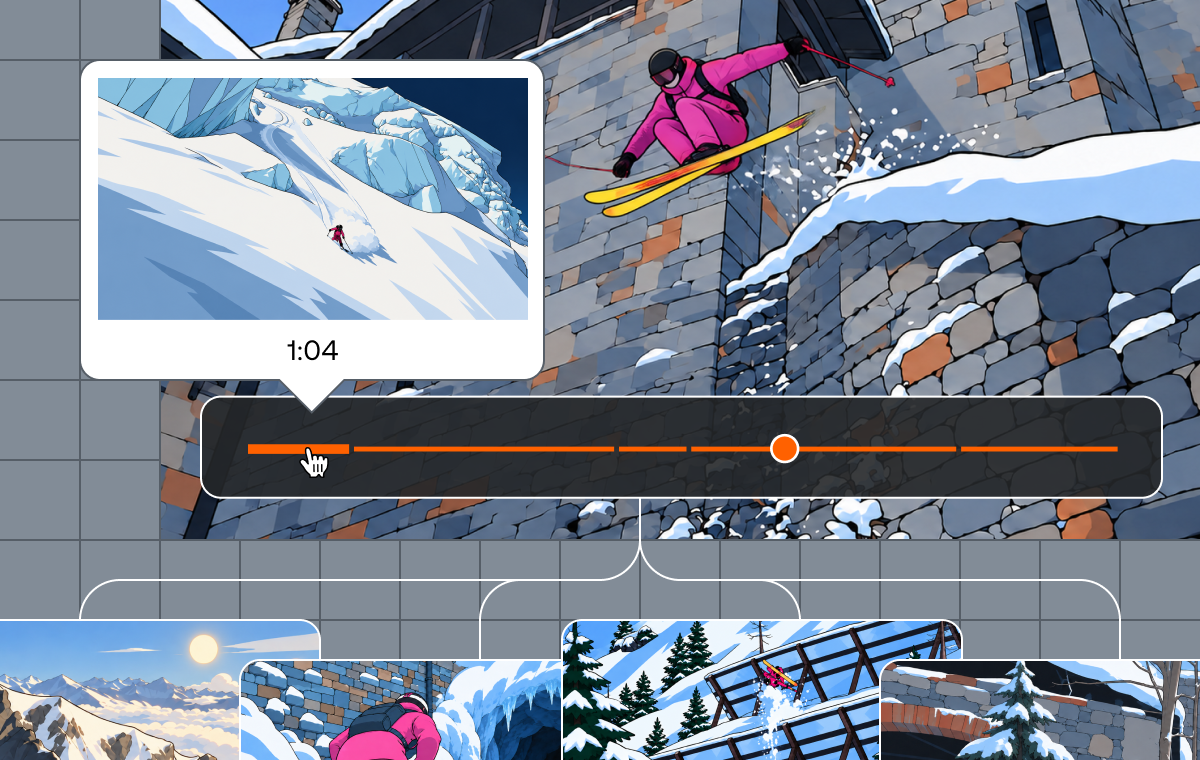
Chronological and Structural Decomposition of Video Data
To understand how automated systems interpret complex visual narratives, industry developers categorize video architecture into distinct layers of granularity. This methodology allows automated pipelines to execute specific tasks—such as thumbnail generation, content moderation, automated clipping, and semantic search—with surgical precision.
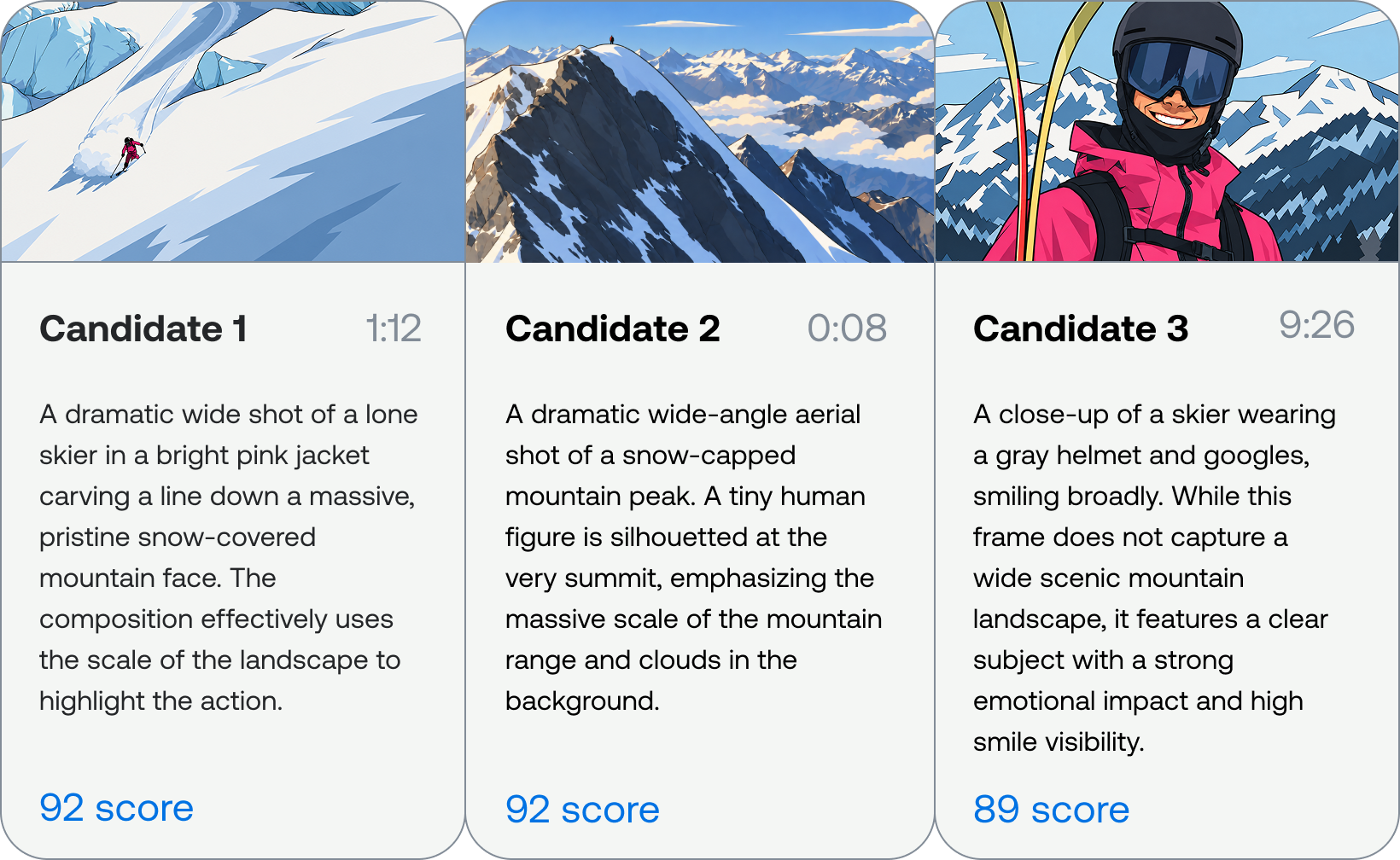
At the most microscopic level lies the individual frame. A single frame is sufficient for answering static questions regarding visual composition, object recognition, branding identification, and compliance moderation. For instance, determining the exact timestamp where a skier achieves maximum vertical altitude or screening a video for policy violations can be achieved by evaluating isolated images. However, static frames fail when temporal context, motion, or narrative progression is required. An isolated frame can capture an athlete mid-air, but it cannot verify whether the landing was successful.
Moving up the structural hierarchy introduces the concept of the shot—defined as a continuous take bounded by camera cuts or scene transitions. Shot-detection algorithms analyze consecutive frames using lightweight visual metrics to identify visual state changes. In high-velocity, densely edited content like extreme sports films, fixed-interval sampling often misses fleeting camera angles or rapid terrain shifts. Shot-aware sampling ensures that distinct visual transitions are captured without forcing the underlying AI model to inspect every single frame. Nevertheless, while shots map visual change, they lack narrative cohesion.
To establish broader context, video processing pipelines utilize scenes. Scenes aggregate neighboring shots that share visual, auditory, or thematic continuity. In environments with minimal spoken dialogue, multimodal AI systems rely heavily on visual cues to group disparate camera angles into a single recognizable sequence, such as an alpine glacier crossing or an urban snow park descent.
Beyond structural segments lie product-driven classifications: key moments and chapters. Key moments identify standalone excerpts—such as a complete athletic trick from approach to landing—tailored for viewer engagement and social media distribution. Chapters, conversely, provide a structured table of contents for navigation, dividing extended video assets into logical, chronologically ordered phases.

Economic Implications and Computational Efficiency
The economic implications of granular video processing are substantial for modern streaming architectures and digital asset management platforms. Processing high-definition video through large multimodal models incurs significant cloud compute expenses. By deploying heuristic-based pre-filters—such as shot boundaries and scene detection algorithms—platforms can prune redundant visual data before invoking resource-intensive AI models.
Industry benchmarks indicate that intelligent frame sampling can reduce computational overhead by up to 70 percent in long-form video archives. This efficiency enables real-time content indexing, automated metadata tagging, and lightning-fast semantic retrieval across massive media repositories. Furthermore, output-steering mechanisms allow platforms to customize AI evaluations based on target audience demographics, ensuring that automated thumbnail selection or highlight generation aligns with specific editorial requirements.

Implications for Future Media Engineering
The intersection of artificial intelligence and video engineering highlights a broader truth within software development: contextual relevance supersedes raw data volume. Providing an AI model with excessive, unmanaged video data frequently degrades performance rather than enhancing it. By systematically matching the granularity of the input—whether a single frame, an isolated shot, or a comprehensive scene—to the specific nature of the query, developers can build more resilient, cost-effective media workflows.
As video libraries continue to expand exponentially across broadcast, enterprise, and user-generated content sectors, the adoption of multi-tiered decomposition frameworks will become standard industry practice. The methodologies demonstrated in analyzing complex visual assets like professional freeskiing films provide a scalable blueprint for automated search, accessibility compliance, and dynamic content curation across the global digital media landscape.